Sage Green Nails: Colour Pairings for a Muted Manicure
Build a muted green palette with ivory, pink, taupe or deeper green, and keep the balance clear.
Archive edition: 2026-05-28 · This is an editorial allocation, not the first-publication date.
Key takeaways
- Sage is a family of muted greens, not a fixed colour code.
- Compare blue-leaning, grey-leaning and warmer green samples side by side.
- Choose one main colour and give any contrasting colour a clear role.
- Match the finish and design scale as carefully as the shade.
In this guide
- Key takeaways
- Start with the particular green
- Choose the role of the second colour
- Pair sage with ivory for a spare design
- Use muted pink when you want a softer contrast
- Try taupe or deeper green for a quieter pattern
- Build the palette in three decisions
- Keep the shape and pattern in proportion
- Make the final brief easy to repeat
- Common questions
- Sources and further reading
Sage green nails can bring a little colour into a neutral manicure without requiring an elaborate pattern. The appeal may be a dusty grey-green, a softer blue-green or a warmer green close to olive. Those are different starting points, even when a saved photograph labels all of them sage. A useful manicure brief makes that difference explicit, then decides how the green will sit beside any second colour.
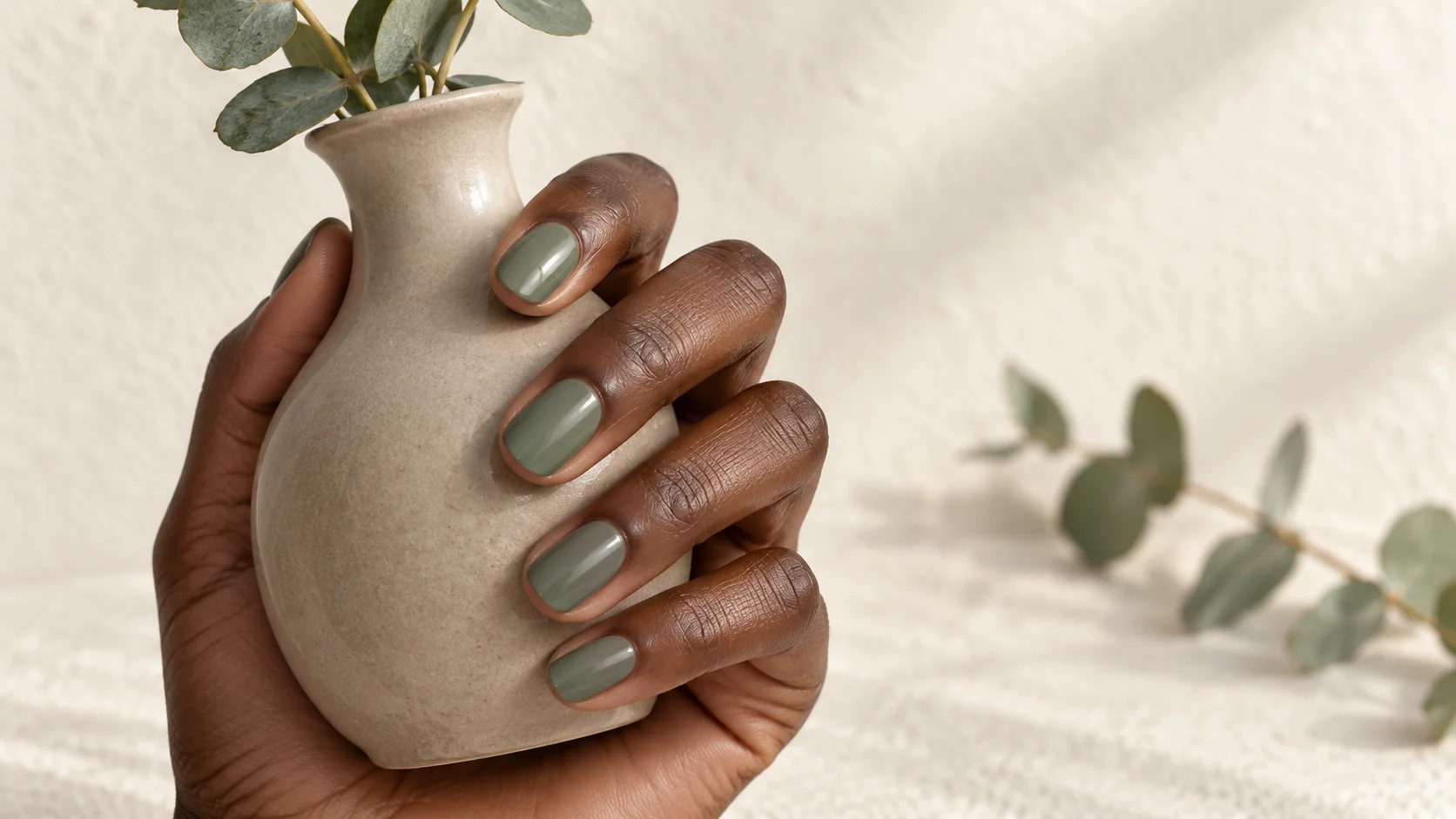
This guide offers ways to plan a muted green palette, from a plain full set to simple paired designs. The combinations are editorial suggestions rather than rules about skin tone or claims about a product’s performance. Our featured image is an AI-generated manicure illustration, not a verified bottle swatch. Use its calm composition as a reference, then assess real samples for the colour you want. More adaptable design ideas sit in our nail art and trends collection.
Start with the particular green
Place two possible greens beside each other and describe what changes. Does one look bluer? Does the other look more grey, more yellow or simply darker? You do not need specialist colour vocabulary to make this comparison useful. A note such as less blue than this sample gives a nail professional more direction than a collection of photographs taken under unrelated lights. Keep one preferred sample as the anchor for the rest of the design.
Brand descriptions can help identify a direction, but they are not a standardised colour chart. Essie’s UK page describes Bling It as muted sage with blue undertones. Its Gourmet Grocery collection describes Crunch Crunch as a dusty seafoam green with subtle blue undertones. Those examples show why a general green category does not settle the exact appearance. We have not tested these products or verified that either matches the illustration.
Choose the role of the second colour
A two-colour manicure becomes easier to plan when one colour has a clear job. Sage can be the main field across most nails, while a second colour appears only as a line or one accent. Alternatively, use a neutral base and let small green details carry the design. An even split can work too, but choose that balance deliberately rather than adding a different colour whenever a nail looks empty.
Sketch five simple nail outlines on paper and mark where each colour would go. Repeat the arrangement for the other hand, or decide on a small intentional variation. This is a layout exercise, not a test of artistic skill. It helps you spot a crowded pattern before using polish and makes it easier to explain which nails should carry the most attention.
| Partner | A simple way to use it | What to compare on a sample |
|---|---|---|
| Ivory | One ivory accent beside a sage set | Whether you like the contrast between the two pale colours |
| Muted pink | A pink base with a small green detail | Whether both colours remain distinct at normal viewing distance |
| Taupe | Alternating plain nails in a limited palette | Whether the taupe looks warmer or cooler beside this green |
| Deep green | A fine line or small corner accent | Whether the darker detail overpowers the muted base |
Pair sage with ivory for a spare design
Ivory can give a sage manicure a clear second colour without introducing another strong hue. Try a plain sage set with one ivory nail, or reverse the balance and use sage for a small curved corner. Keep the finish consistent if you want the colour difference to be the main feature. A glossy sage beside a strongly reflective pearly ivory introduces two changes at once, which may be more than your brief needs.
Before adding white lines or tiny leaves, look at the two plain colours together. The pairing might already provide enough interest. If you do add a line, decide whether it should follow the nail edge or cut across the surface. One repeated movement will usually be easier to describe and reproduce than a different decorative idea on every finger.
Use muted pink when you want a softer contrast
Pink and sage offer a different kind of contrast from green and ivory. Try a small green dot on a translucent pink base, a simple green tip or one pink accent among plain sage nails. These are starting points, not prescribed formulas. The best balance for your brief depends on how noticeable you want the design to be and how much of each colour you want to see.
Keep the pink’s coverage in mind. A sheer base allows the nail beneath to remain part of the overall appearance, while an opaque pink creates a separate block of colour. Compare those options before asking for exactly the same green detail on both. If a delicate green line seems to disappear, change its size or contrast; do not assume every reference will read equally clearly on every base.
Try taupe or deeper green for a quieter pattern
Taupe is another broad colour label, so compare the actual pair rather than choosing two names from a list. A warmer taupe may give you a different result from a greyer one. Start with plain samples and decide whether alternating nails feels coherent to you. If the colours seem too similar, make the difference more deliberate or simplify to a single-colour set.
A deeper green can add definition without taking the design into a completely different colour family. Use it sparingly at first: a small corner, a short line or a single accent nail. Check the set from arm’s length. If all you notice is the dark mark, reduce its area or choose a smaller difference between the two greens. This is a practical way to preserve the muted effect that attracted you to sage.
Build the palette in three decisions
- Anchor. Pick the exact green direction from physical samples.
- Balance. Decide which colour covers most of the set and which supplies the accent.
- Repeat. Use one shape or mark consistently, then check the whole hand at a comfortable distance.
Keep the shape and pattern in proportion
A muted colour does not require a particular nail length. Use the outline you want to maintain, then fit the pattern to the available surface. OPI’s nail shape guide distinguishes a curved oval outline from a square free edge and describes squoval as their combination. Those terms can help explain a reference; they do not mean you need a certain finger shape to choose green polish.
On a short nail, a broad band may use most of the visible surface. If you want the base colour to remain prominent, reduce the band’s width or move to one small detail. If precise repeated lines are not enjoyable to paint, use plain alternating colours instead. The design should suit the time and effort you want to give it, as well as the picture you want at the end.
Make the final brief easy to repeat
For an ordinary-polish sample, follow the selected products’ directions and record the shade, coat count and finishing product. Judge it in daylight and your usual indoor lighting, beside clothes or jewellery you regularly wear. A photograph can help you remember the layout, but keep a note of the actual colour names because camera processing can alter the impression. Do not treat this colour-planning guide as instructions for a gel system.
A concise salon brief might be: muted blue-grey sage, short oval shape, plain glossy finish, one ivory accent and no additional art. Change any part of that sentence to suit your preference. Ask to compare the proposed colours together before committing to the full set. With the green, balance and finish settled, you can make a small future variation without having to redesign the entire manicure from scratch.
For the related design decisions, compare Butter Yellow Nail Ideas for Soft, Wearable Colour, Mocha Nails: Choosing Chocolate, Taupe and Coffee Tones and Skittle Nails: Building a Five-Colour Palette That Feels Cohesive. For the practical details, use Choosing a Nude Nail Polish: Undertones, Coverage and Personal Preference.
Common questions
Is sage green the same as mint or seafoam?
Those names can overlap in everyday descriptions, but they do not guarantee the same shade. Compare the actual greens for differences in blue, grey, yellow and depth. If one sample is closer to your aim, use it as the reference instead of relying only on a colour label.
Can sage green work as a plain manicure?
Yes. A single green across the set is a complete design choice and a useful way to judge the colour itself. Pick the finish you want, compare a real sample and keep the outline comfortable. Extra art is optional; you do not need an accent to make the manicure intentional.
What neutral colours can I pair with sage nails?
Ivory and taupe are useful starting points, but compare the exact products together because both names cover different colour directions. Choose one main colour and one supporting role. A plain accent nail or alternating colours can show the pairing without requiring detailed brushwork or extra decoration.
How can I combine sage green with pink?
Try a green detail over a pink base, a green tip or one pink accent among sage nails. Decide whether the pink should be sheer or opaque before choosing the pattern. The same detail can read differently on those bases, so compare a sample at ordinary viewing distance.
Do I need long nails for sage nail art?
No. Start with your preferred length and adapt the scale of the design to it. A small dot, a corner accent or plain alternating colours can be planned on a short surface. Reduce the number of elements if a reference from longer nails makes your version feel crowded.
Should all the colours have the same finish?
Matching finishes is one straightforward option when you want the colour pairing to be the main feature. Mixing a plain colour with a pearly or strongly reflective accent can also be deliberate. Compare the complete combination first, because a new finish introduces another visible difference beyond the shade.
How do I stop a dark green accent dominating the set?
Start with a smaller mark or a shade closer to the main sage. Look at the whole hand from a comfortable distance instead of inspecting only the accent. If the dark area is the first and only thing you notice, reduce its size or return to plain colour.
Can I recreate the exact green in the featured image?
The featured image is an AI-generated illustration, so it does not identify an exact bottle or verified colour result. Use it to explain the general mood and layout. Compare physical samples with your nail professional, and keep a record of the chosen shade and finish for a repeat manicure.
Sources and further reading
- Essie UK — Bling It — checked 2026-10-21
- Essie UK — Gourmet Grocery collection — checked 2026-10-21
- OPI — How to find the best nail shape for your hands — checked 2026-10-21