How to Measure Your Nails Before Buying a Press-On Set
Record all ten nails in millimetres, match the seller’s measurement method and check curve and tip size before committing to a set.
Archive edition: 2026-05-09 · This is an editorial allocation, not the first-publication date.
Key takeaways
- Method: confirm curved or other seller-defined dimensions.
- Ten measurements: record each nail separately in millimetres.
- Chart: use the exact product range without invented conversions.
- Fit: consider curve, length and a sizing sample where available.
In this guide
- Key takeaways
- Find the chart for the exact range
- Check whether the method follows the nail’s curve
- Measure one nail at a time and label it immediately
- Compare measurements without inventing precision
- Handle between-size advice as product-specific
- Remember that curve and length still need checking
- Check the kit contents before placing the order
- Method, ten measurements, chart, fit
- Common questions
- Sources and further reading
Measuring before buying can help you compare a press-on set with your own nails, but the numbers need to match the seller’s method. A curved surface measurement is not necessarily the same as a straight width viewed from above. Check what the chart describes before collecting figures.
Record every nail on both hands, keep the units clear and treat the result as a starting point for fit. Width alone does not capture every curve or base shape. A sizing kit or direct clarification may be more useful than pretending that a rough measurement guarantees a perfect match.
Find the chart for the exact range
Look for the shape, length and product family you intend to buy. A general brand chart may not map every individual tip size in every style. Save the page or product reference with the measurements so you know what you compared.
Glamnetic’s measurement guide, for example, lists different width and length ranges for different shapes. A range shows the overall span available; it does not necessarily provide a complete mapping from each printed tip number to a millimetre width.
If the seller only gives small, medium and large, ask what those labels mean for the specific set. Do not assume that your size in another brand transfers. The same label can describe a different selection of tips or dimensions.
Check whether the method follows the nail’s curve
MuseMoodNails’ sizing guide asks for the widest sidewall-to-sidewall measurement across the curved natural nail and describes a paper or tape method. That is an example of a seller-defined process. Confirm that the seller you are ordering from requests the same kind of measurement.
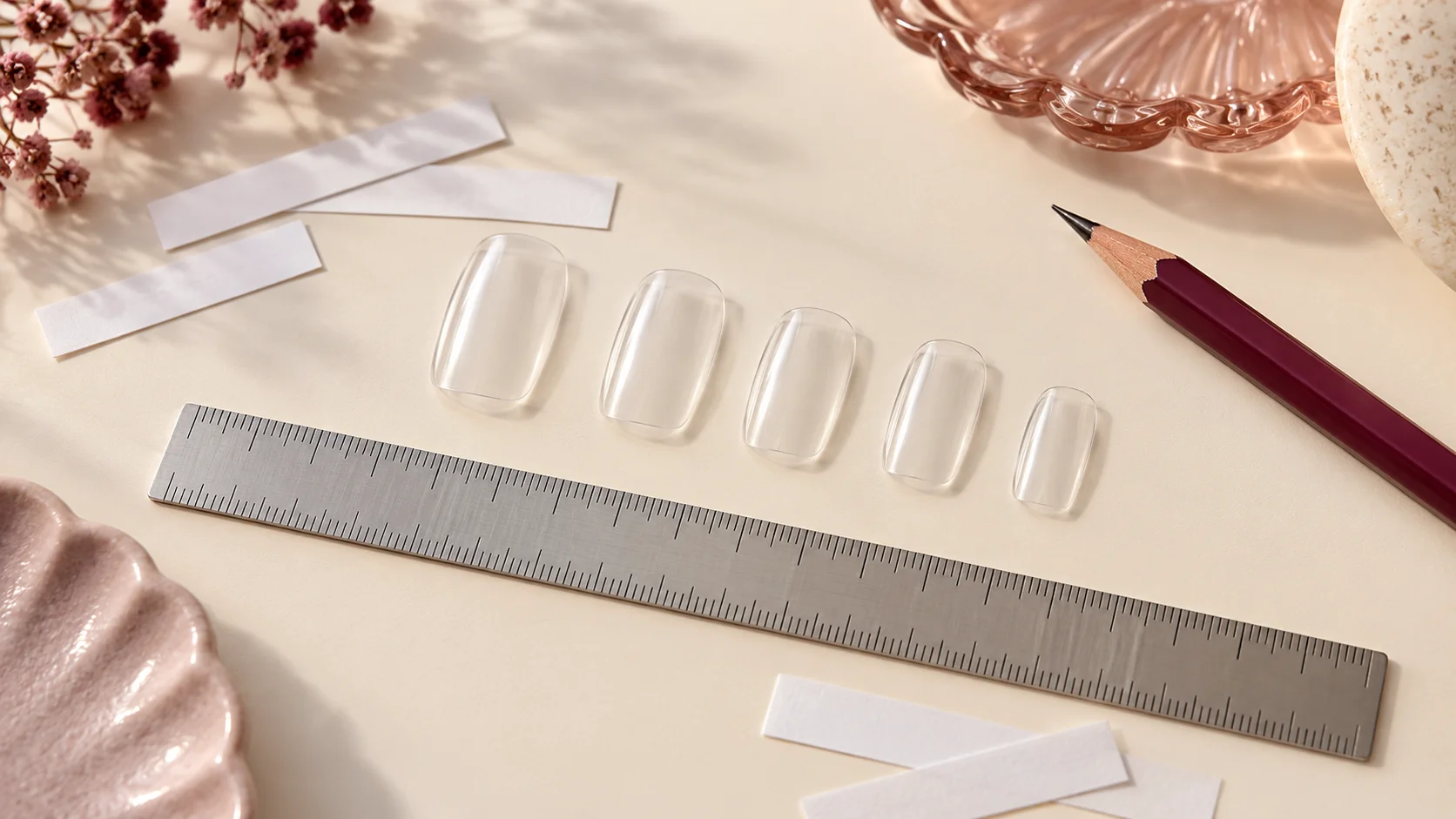
For a curved-width method, a narrow flexible paper strip can follow the nail’s surface without being pulled tight around the finger. Mark where the natural nail edges meet the strip, then lay the strip flat against a millimetre ruler and read the distance between the marks.
Keep the strip on the nail rather than measuring the surrounding skin. Use an ordinary comfortable position and do not press or squeeze to make the reading smaller. If using adhesive tape is uncomfortable or unsuitable for your skin, use a non-adhesive method accepted by the seller or request another option.
Measure one nail at a time and label it immediately
Start with one hand and record thumb, index, middle, ring and little finger in order. Repeat for the other hand rather than copying the first set of figures. A clear order prevents a good measurement from being assigned to the wrong finger.
Write the unit beside the number. Millimetres and centimetres should not be mixed, and a printed tip-size number is a different kind of information. Keep the original measured width separate from the eventual size you select from a particular chart.
Repeat a reading if the marks are unclear or the result seems inconsistent. Do not average two different methods or add a guessed allowance simply because the chart is inconvenient. Recheck the method and ask the seller when the uncertainty would affect the order.
| Finger | Left-hand measurement | Right-hand measurement | Confirmed tip choice |
|---|---|---|---|
| Thumb | Record in mm | Record in mm | Keep left and right separate |
| Index | Record in mm | Record in mm | Use the exact range chart |
| Middle | Record in mm | Record in mm | Check available sizes |
| Ring | Record in mm | Record in mm | Note any uncertainty |
| Little finger | Record in mm | Record in mm | Confirm before ordering |
Compare measurements without inventing precision
A ruler and hand-marked strip have practical limits. Record what you can reasonably read rather than adding decimal places that the method cannot support. If the decision falls between two options, uncertainty should lead to another check, not a more elaborate-looking number.
Match the units and measurement definition on the chart. A tip’s total length is not its width, and the length does not tell you how far it will extend beyond your own fingertip without considering the fit. Read the column headings carefully.
If the chart provides only a smallest and largest width, that does not prove every measurement in between has a matching tip. Ask about the available sizes or a sizing sample. Do not build an unofficial conversion table by dividing the range into equal steps.
Handle between-size advice as product-specific
Manufacturers can give different between-size instructions. Olive & June’s fitting advice discusses its own sizing choices and warns against forcing an uncomfortable nail. Another seller may describe adjustment of a slightly larger tip within its own system.
Do not combine those rules into a universal instruction to always size up or always size down. Use the guidance for the actual range and confirm whether any alteration is supported. A product-specific rule does not mean a painful or visibly unsuitable fit must be accepted.
If neither option appears workable, ask about another style or a sizing kit. Extra adhesive and force should not be used to resolve a fit that remains uncertain. It is better to clarify the order than to discover the mismatch after attachment.
Remember that curve and length still need checking
Two tips with similar widths can sit differently because of their profile. A numerical match therefore does not replace a dry fit where that is possible. Check how the tip follows the nail without pressure and whether the edges overlap surrounding skin.
Choose a length that fits your routine and any work requirements. A chart can help compare dimensions, but it does not decide which outline you will enjoy using. Consider the daily tasks that matter before choosing the longest style in a preferred colour.
If a seller offers a sample kit, confirm that it corresponds to the exact shape or mould you intend to order. A sample from a different range may not answer the same fit question. Keep its identification with your recorded size choices.
Check the kit contents before placing the order
Ask whether the set contains duplicates of the sizes you need or a fixed ten-nail selection. That matters when several fingers require the same tip size. Do not assume a large total nail count guarantees the exact distribution you need.
For a custom order, send measurements in the seller’s requested format and confirm which hand each sequence describes. Keep a copy of the information supplied. If you later correct a measurement, make the change clear before production or dispatch where possible.
Read the relevant ordering and return information as part of the purchase decision. This guide does not promise that a fitted, opened or customised set can be returned. Clarify uncertainties about size before committing rather than relying on an assumed return route.
Method, ten measurements, chart, fit
- Method: confirm curved or other seller-defined dimensions.
- Ten measurements: record each nail separately in millimetres.
- Chart: use the exact product range without invented conversions.
- Fit: consider curve, length and a sizing sample where available.
Keep the final size record with the brand and style, not as a universal number for every future set. Explore the Press-On Nails section for attachment and removal questions once the fit decision is clear.
To complete the fit, wear and removal plan, read Press-On Nails for Wide Nail Beds: Fit Questions to Check, Press-On Nails for Narrow Nail Beds: Size and Curve Explained and Press-On Nail Curvature: Why a Size Can Fit but Still Feel Wrong. For the related care, tool or design decision, see Almond, Oval or Squoval: A Visual Guide to Nail Shapes.
Common questions
Should I measure the curved surface or straight width?
Use the method requested by the seller for the exact chart. Some ask for sidewall-to-sidewall width following the nail’s curve, which differs from a straight top-down measurement. Confirm the definition before collecting numbers instead of assuming every manufacturer measures its tips in the same way.
How does the paper-strip method work?
For a seller that requests curved width, follow a narrow flexible strip across the natural nail, mark the nail edges and measure between those marks after laying it flat against a millimetre ruler. Avoid squeezing the finger, and confirm that this method matches the chosen seller’s instructions.
Do I really need to record all ten nails?
Yes, check both hands rather than assuming matching fingers are identical. Label each measurement immediately with the hand, finger and unit. This keeps an accurate reading from being assigned to the wrong nail and helps when a custom order asks for two separate size sequences.
Is a tip size number the same as millimetres?
No. A printed size number identifies a tip within a particular range; it is not automatically a width measurement. Keep your measured millimetres separate from the selected tip number and save the brand, style and chart reference with the record for future use.
Should I always size up if I fall between options?
Do not apply one universal rule. Manufacturers give different instructions for their own ranges, including whether adjustments are supported. Recheck the measurement and ask the seller when necessary. A product-specific suggestion is not a reason to accept pressure, pain or a visibly unsuitable fit.
Does a matching width guarantee a comfortable fit?
No. Curve, base shape and the actual tip design also matter. Use a dry fit or a relevant sizing sample where available, and do not force a tip into place. A numerical comparison is a starting point rather than a complete assessment of how the nail sits.
Can I calculate missing sizes from the widest and narrowest tips?
Do not invent a tip-number conversion by dividing the range into equal steps. An overall width range does not show every individual size or guarantee each intermediate measurement exists. Ask for the exact chart or a sizing sample if the missing information affects your choice.
What else should I check before ordering?
Confirm the shape and range, duplicate sizes included, custom-order format and relevant return information. Several fingers may need the same size, so total nail count alone is not enough. Resolve uncertainties before committing rather than relying on an assumed ability to return an opened or customised set.
Sources and further reading
- MuseMoodNails — Measuring guide — checked 2026-10-21
- Olive & June — Choosing press-on size — checked 2026-10-21
- Glamnetic — Nail shape measurements — checked 2026-10-21