Reusable Press-On Nails: How to Check Care Instructions Before Buying
Check the exact range, compatible adhesive, removal route and condition requirements before budgeting for another wear of a press-on set.
Archive edition: 2026-06-22 · This is an editorial allocation, not the first-publication date.
Key takeaways
- Policy: identify what the exact range supports.
- Method: confirm adhesive, removal and cleaning instructions.
- Condition: reassess the tips and your nails before another wear.
- Record: keep size, product and use details together.
In this guide
- Key takeaways
- Find the reuse policy for the exact range
- Distinguish supported reuse from a possible second attempt
- Read the adhesive and removal conditions together
- Ask how the fitting surface should be cleaned
- Check condition before considering another application
- Store identification with the set
- Compare total cost without assuming every wear happens
- Policy, method, condition, record
- Common questions
- Sources and further reading
A reusable press-on set needs more than a tip that happens to survive removal. Check whether the manufacturer supports another wear of that exact range, which adhesive and removal method it requires, and how the tips should be cared for between applications. Those details are more useful than a broad reusable label.
This is a buying and care-information guide, not a hands-on durability test. It compares what manufacturers say and offers a way to assess the conditions attached to those statements. It cannot promise that a particular set will last a fixed number of applications on your nails.
Find the reuse policy for the exact range
Brands can sell both single-use and potentially reusable systems. Do not treat a statement on one product page as a policy for the whole collection. Save the range name, attachment system and current care instructions together.
KISS’s FAQ says its nails are designed for one-time use, with an exception for ICON. For that named range, the company describes up to three wears: two using the included tabs and one with glue. This is a manufacturer’s conditional description, not a result we have tested.
The detail matters as much as the headline number. It does not mean every KISS set can be worn three times or that three glue applications are supported. If the package you buy gives different instructions, clarify the current guidance for that exact product.
Distinguish supported reuse from a possible second attempt
A company may describe a product as intended for one manicure while acknowledging that some customers have worn it again. That is a different level of assurance from providing a defined reuse routine. Neither should be rewritten as an unlimited-wear promise.
The current Glamnetic reuse FAQ describes its press-ons as designed for one manicure and says a second use is not promised. Older marketing, retailer descriptions or social-media experiences may use different wording. Check the current information before buying on the assumption of repeated wear.
If reuse is central to your decision, an uncertain answer is meaningful. You can compare another range with clearer care information rather than budgeting around a second application that the manufacturer does not support with a dependable process.
Read the adhesive and removal conditions together
Olive & June’s system-specific FAQ distinguishes Instant Mani, whose reuse depends on careful removal, from Super Stick Mani, which is designed for one-time use. Similar-looking finished nails therefore do not necessarily share the same reuse plan.
The company’s removal guide also states that its dedicated removal-system route does not preserve tips for reuse. That distinction is useful when comparing a product’s complete routine. It is not a general claim that warm water makes every press-on reusable.
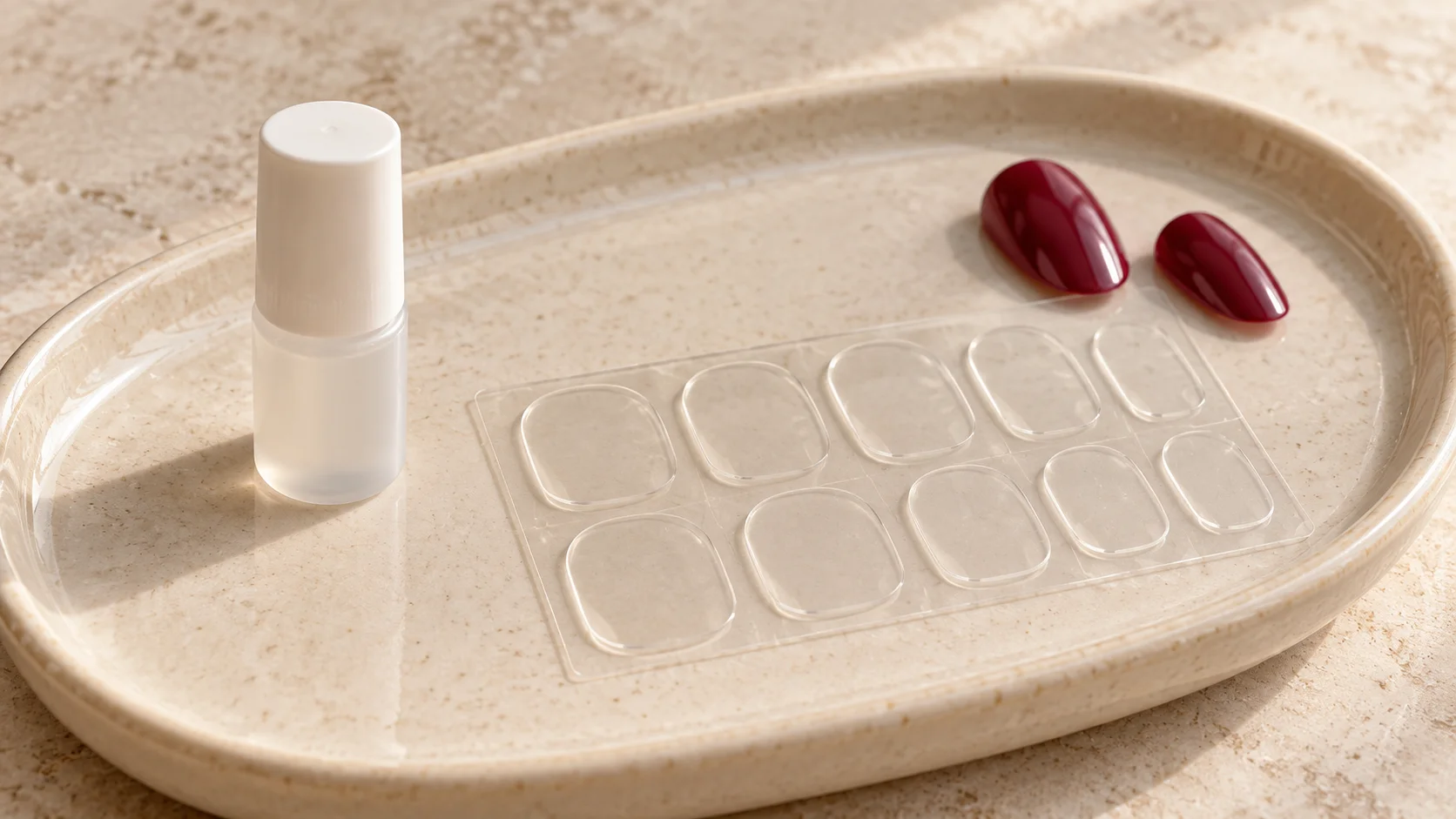
Before application, decide which supported removal method you can realistically follow. Do not substitute an adhesive and assume the original reuse instructions still apply. Ask about the combination if you intend to use something other than the supplied system.
| Manufacturer statement | What it supports | What it does not establish |
|---|---|---|
| Designed for one use | Plan the purchase around one manicure | A reliable second wear because the tip looks intact |
| A second use may be possible | Some uncertainty remains | A guaranteed number of repeat applications |
| Reuse with a specified method | Read that method and its conditions | Compatibility with every adhesive or remover |
| Up to a stated number of wears | A maximum claim under the stated conditions | The same result for every user or every tip |
| No clear care information | A reason to ask before buying | Permission to invent a cleaning or restoration method |
Ask how the fitting surface should be cleaned
Removal and preparation for another wear are separate questions. Ask how the manufacturer wants old adhesive dealt with on the underside of the tip, and whether the required product is compatible with its material and decoration. A clean-looking top surface does not answer that question.
Do not create a universal routine using acetone, alcohol, boiling water or household disinfectant. These products and methods are not interchangeable, and this guide has not verified them for your set. Likewise, do not use a drill to grind away residue without an appropriate product-specific professional process.
If the seller only repeats that the set is reusable but cannot explain the cleaning requirements, record that limitation in your comparison. A promise is less useful when the practical steps needed to achieve it remain unspecified.
Check condition before considering another application
Look for a changed shape, cracks, damaged edges or decoration that is coming away. These are reasons to pause rather than restore the appearance with an improvised repair. Follow the manufacturer’s criteria for retiring the tips, and ask when those criteria are missing.
Recheck fit too. The fact that a tip fitted once does not mean a bent or altered version should be pressed back onto the same finger. An adhesive should not be used to conceal a change in the fitting surface.
Keep nail and skin comfort in the decision. If the previous wear or removal caused a problem, do not proceed solely because the artificial tip still looks attractive. Seek appropriate advice about the concern before another application.
Store identification with the set
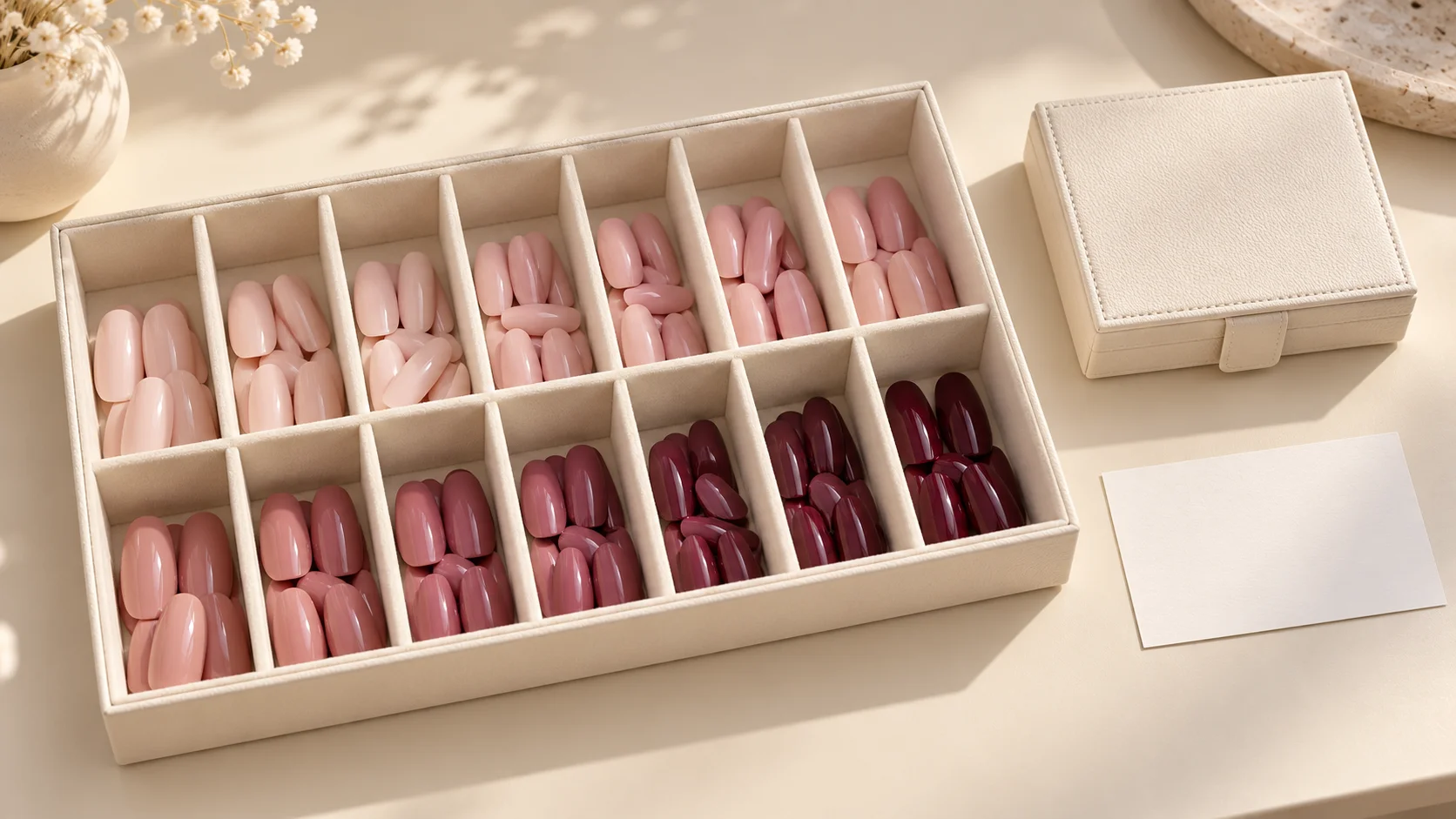
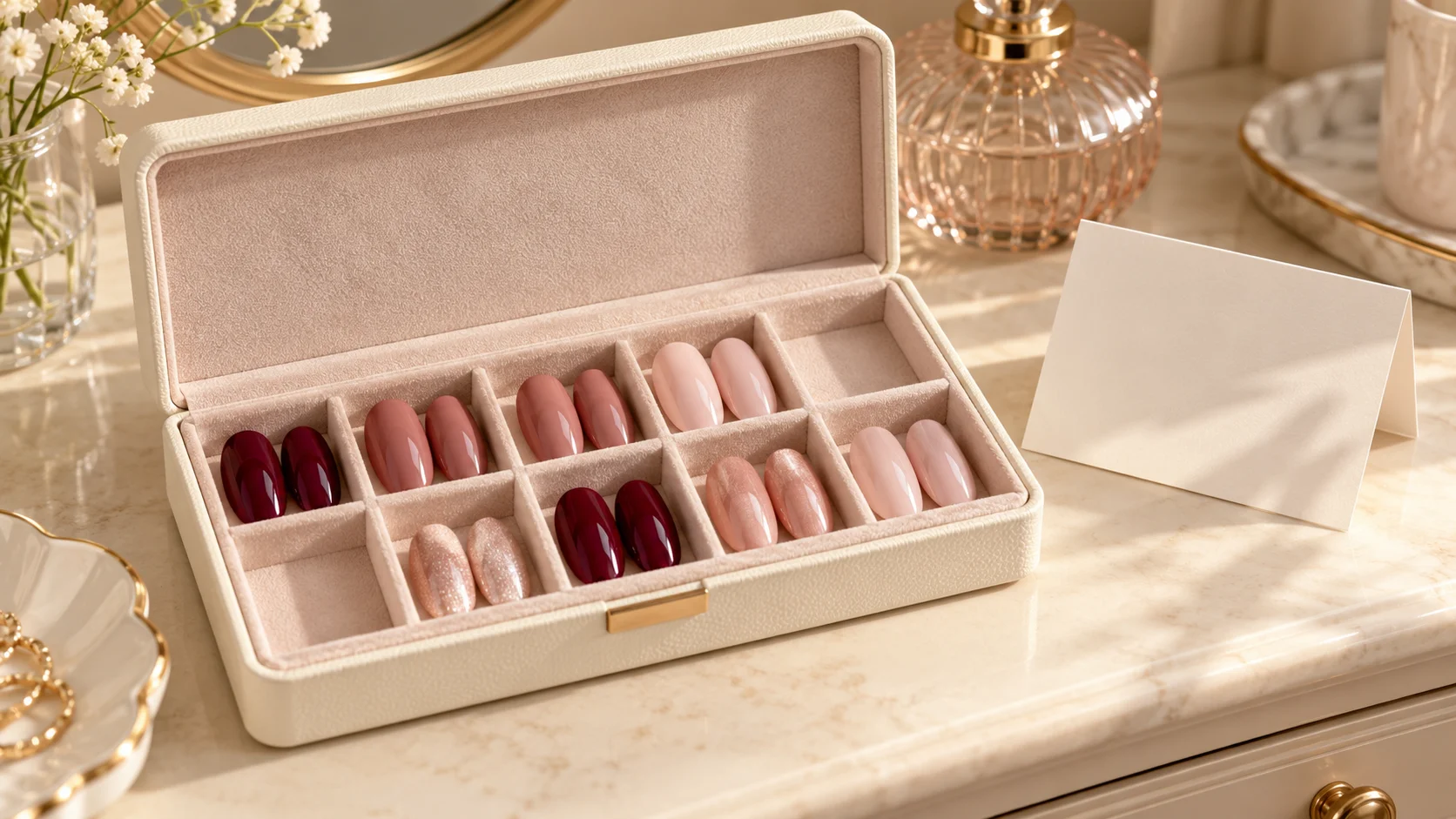
Follow any supplied storage instructions and keep the tips organised so that their sizes and range remain identifiable. A labelled compartment or original case can help you avoid mixing similar designs from different systems. The purpose is to preserve useful information, not to imply that a storage box sanitises its contents.
Keep the care leaflet or a saved reference with the set. Note the adhesive and removal route used, because those choices may affect whether another application is supported. If the system has a stated maximum number of wears, keep a simple record rather than relying on memory.
Do not transfer glue or remover into an unlabelled cosmetic pot to make the storage look neater. Keep those products in their original containers with their warnings and follow their own storage directions, away from children and pets.
Compare total cost without assuming every wear happens
Include the set, any compatible replacement adhesive, the specified remover and any necessary storage or care supplies in your comparison. A higher initial price does not automatically produce a lower cost per manicure, particularly when repeated wear is uncertain.
Use two simple scenarios: the cost if you obtain one suitable manicure and the cost if the manufacturer’s supported reuse works for you. Label the second as a possibility. Do not divide the purchase price by an optimistic number taken from a review and present that as a guaranteed saving.
Similarly, reuse wording alone does not establish a complete environmental advantage. Materials, packaging, care products and actual disposal all affect that question. Without suitable evidence, treat the ability to consider another wear as a product feature rather than a broad sustainability claim.
Policy, method, condition, record
- Policy: identify what the exact range supports.
- Method: confirm adhesive, removal and cleaning instructions.
- Condition: reassess the tips and your nails before another wear.
- Record: keep size, product and use details together.
Before buying, ask the seller one complete question: what steps and conditions must be met for another application of this exact set? Keep the answer with your order. The Press-On Nails section covers the fit and removal decisions that complete the comparison.
To complete the fit, wear and removal plan, read How to Remove Press-On Nails Using the Manufacturer's Method, How to Store Press-On Nails and Keep Sizes Together and How to Compare Press-On Sets Without Relying on Wear-Time Claims. For the related care, tool or design decision, see How to Keep a Personal Manicure Kit Clean and Organised.
Common questions
Are all press-on nails reusable?
No. Manufacturers distinguish between single-use ranges, conditionally reusable systems and products where another wear is only a possibility. Check the exact range and current care instructions. A tip surviving removal does not by itself establish that the manufacturer supports another application.
Does an up-to-three-wears claim guarantee three manicures?
No. Read the conditions attached to the claim, including the permitted adhesive sequence and removal process. A maximum description is not a personal guarantee for every tip or user. Do not extend a statement about one named range to an entire brand’s collection.
Can I change the adhesive and keep the same reuse plan?
Do not assume that the original instructions remain valid after a substitution. The adhesive and removal method are part of the system’s reuse conditions. Ask the manufacturer about the actual combination before applying it, particularly if repeated wear is important to your purchase decision.
Can I clean every used tip with alcohol or acetone?
There is no universal cleaning routine established here. Ask for the method compatible with the particular material, finish and old adhesive. Do not substitute household disinfectants, boiling water or another solvent simply because the tip looks intact or a different brand allows that approach.
What if a tip is bent or cracked after removal?
Pause rather than trying to make it fit with more adhesive or an improvised repair. Follow the manufacturer’s criteria for retiring damaged tips. If those criteria are unclear, ask before reuse; the fact that the design still looks attractive does not resolve a changed fitting surface.
Does a storage case make used nails ready to wear again?
No. A case can keep sizes and product identities organised, but it does not establish that cleaning requirements have been met or that the tips remain suitable. Follow the care instructions and recheck condition and fit before considering another supported application.
How should I estimate the cost of a reusable set?
Include the set and any required compatible adhesive, remover and care supplies. Compare a one-manicure scenario with a clearly labelled possible-reuse scenario. Do not present an optimistic number of applications from a review as a guaranteed saving or the cost you will definitely achieve.
Is reusable automatically an environmental claim?
No. Reuse is one product feature, while broader environmental effects also involve materials, packaging, care products and disposal. Without appropriate evidence, do not treat a reusable label as proof of an overall environmental advantage. First establish what repeat use the manufacturer actually supports.
Sources and further reading
- KISS — Nails FAQ — checked 2026-10-22
- Olive & June — Reuse by system — checked 2026-10-22
- Glamnetic — Can I reuse the nails? — checked 2026-10-22
- Olive & June — Press-on removal — checked 2026-10-22