Gel Polish and UV Lamps: Safety Questions Worth Asking
Understand what nail-lamp research can tell you, discuss UV exposure precautions, and check that the curing system matches the product.
Archive edition: 2026-07-13 · This is an editorial allocation, not the first-publication date.
Key takeaways
- System: identify the product and recommended lamp.
- Evidence: distinguish cell experiments from human outcomes.
- Precautions: discuss covered and exposed skin.
- Choice: keep an alternative finish available.
In this guide
- Key takeaways
- Ask what the lamp does for the exact product
- Read laboratory findings at the right scale
- Understand what an exposure precaution can do
- Do not shorten curing as a safety experiment
- Check reassuring words for a clear meaning
- Bring personal concerns into the consultation early
- System, evidence, precautions, choice
- Make the decision without a false guarantee
- Common questions
- Sources and further reading
Questions about gel-polish lamps are easier to answer when two issues are kept separate: exposure to ultraviolet light and contact with the nail products being cured. A precaution for one does not automatically solve the other. Sunscreen, for example, does not establish whether a particular gel has cured correctly.
This guide explains what to ask before a service and how to read the evidence without turning it into an unsupported promise. It does not calculate your personal cancer risk or supply a home curing schedule. Those answers cannot be obtained from the lamp’s appearance, a wattage label or a photograph of a finished manicure.
Ask what the lamp does for the exact product
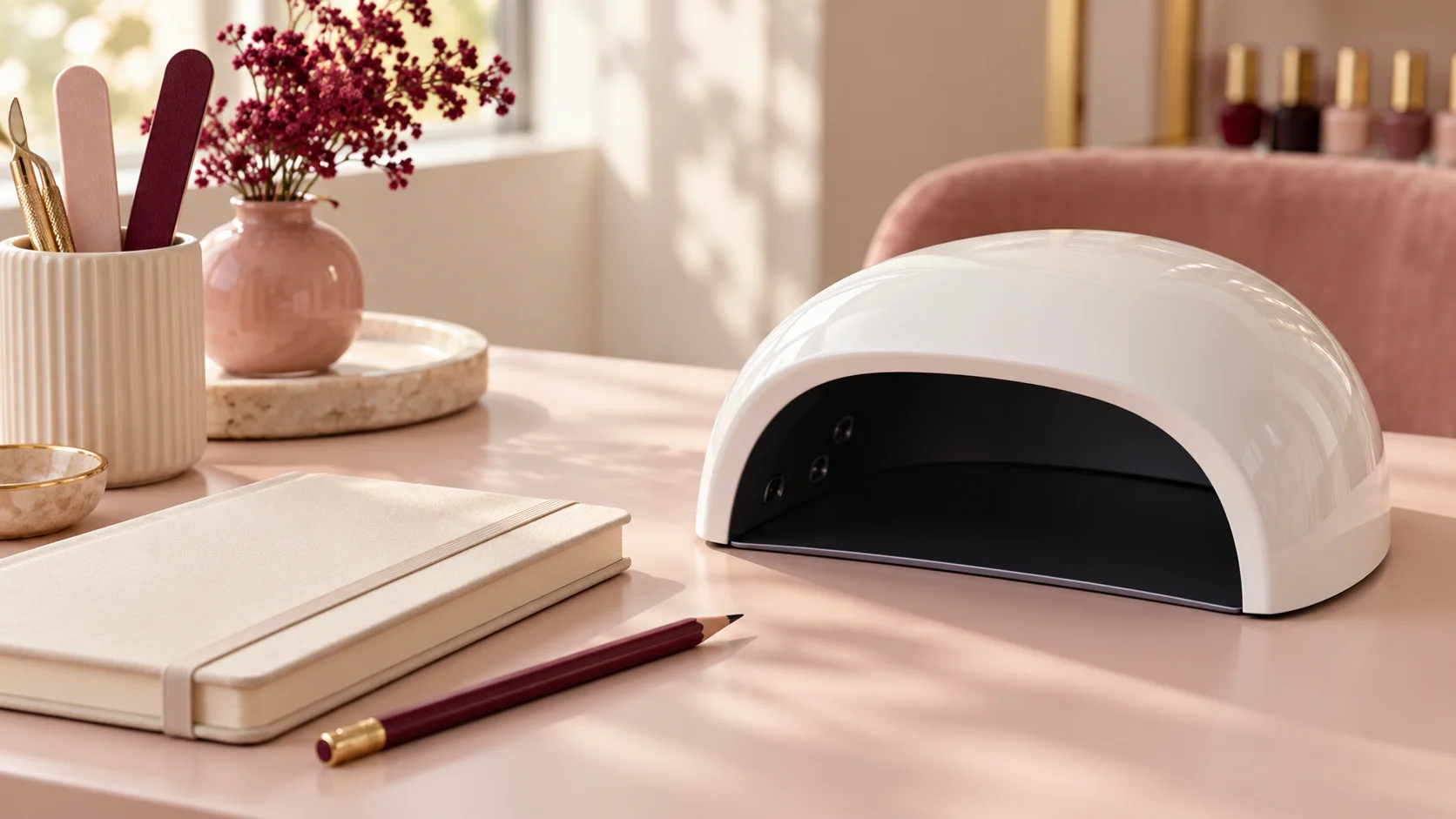
Start with the product and lamp combination rather than the lamp alone. Ask the provider which system is being used and whether the equipment and application follow its current instructions. If there are several gel layers, the answer needs to account for the products actually being applied.
The British Association of Dermatologists warns that insufficient curing and contact with uncured nail products can contribute to allergy risk. Its advice includes using the recommended lamp. A light that switches on is not, by itself, evidence of a suitable curing arrangement.
A useful answer names the system and explains how its instructions are followed. “It is a powerful lamp” or “we use it for everything” leaves the compatibility question unresolved. You do not need to reverse-engineer the equipment; you can ask the provider to clarify the basis for the choice.
Read laboratory findings at the right scale
A 2023 study by Zhivagui and colleagues examined cells exposed to a nail-polish dryer. The researchers reported DNA damage and mutations in cultured human and mouse cells. This is relevant evidence about a biological effect under the experimental conditions.
It was not a study following salon clients to count how many developed cancer. Cultured cells, exposure arrangements and experimental schedules cannot simply be translated into a personal lifetime percentage or a claim that one appointment causes cancer. The study also does not prove that ordinary use is risk-free.
Keep those two limits together when reading a headline. “Damage was observed in an experiment” and “the size of the risk for a particular person is established” are different conclusions. A careful article should tell you which kind of evidence it is describing rather than moving silently from one to the other.
Understand what an exposure precaution can do
The American Academy of Dermatology’s gel-manicure guidance recommends a broad-spectrum, water-resistant sunscreen rated SPF 30 or higher on the hands before a manicure, or dark opaque gloves with the fingertips exposed. These are precautions against ultraviolet exposure, not a certification that the whole service is without risk.
Discuss the plan before application so skin protection and the product instructions can both be considered. Follow the sunscreen’s directions, and check the coverage and fit of any gloves intended for the purpose. The nail area and any other uncovered skin remain exposed.
Do not treat a generated photograph, decorative fabric or a seller’s attractive colour as evidence of protective performance. Ask for meaningful product information. If you cannot establish what a protective item is intended to do, its appearance is not a substitute for that missing detail.
| Question | What it helps clarify | What it does not prove |
|---|---|---|
| Which product and lamp are used? | The actual curing system | Zero allergy or UV risk |
| What do the current instructions require? | How the service should be performed | A universal time for every gel |
| What skin protection can I use? | A plan for covered skin | Protection of every exposed area |
| What did this study measure? | Laboratory effects or human outcomes | A personal risk percentage |
| Can I choose another finish? | An alternative service decision | That every alternative suits every person |
Do not shorten curing as a safety experiment
It may seem logical to reduce exposure by stopping a curing cycle early. That creates a separate question about whether the product has been processed according to its instructions. Do not improvise a shorter cycle, altered layer thickness or different lamp as a personal workaround.
If you are uncomfortable with the proposed exposure, discuss another service before application. You can ask about ordinary air-drying polish or leave the nails bare. Choosing a different finish is more straightforward than changing a technical process after uncured product has already been applied.
Likewise, extra repeated cycles are not a general remedy for uncertainty. If the product, equipment or application is unclear, the provider needs to resolve that issue. A client should not be expected to design a curing protocol by trial and error.
Check reassuring words for a clear meaning
Do not use the term “LED” as a stand-alone answer to an ultraviolet-exposure question. Ask what the particular unit emits and what product system it supports. A category label or advertising phrase does not tell you the full exposure conditions of your appointment.
Be equally cautious about unqualified claims such as “medical grade”, “completely safe” or “works with all gels”. Ask what the statement specifically means and where the supporting instructions can be found. If the answer concerns electrical operation, it may not answer a question about product compatibility or skin exposure.
You do not need to challenge every technical detail at the desk. Concentrate on the information that affects your choice: the actual system, the recommended process, the proposed precautions and the options if you prefer not to proceed.
A smooth surface or a long-lasting manicure is not a measurement of the light exposure involved. Likewise, a review saying that a lamp feels comfortable does not supply its technical specifications. Keep consumer experience and the manufacturer’s system information in their separate roles when comparing equipment claims.
Bring personal concerns into the consultation early
If you have a condition, medicine or previous advice that makes light exposure a concern, ask the clinician or pharmacist who knows your circumstances before booking. Give them the relevant service details. A general beauty article cannot decide whether a particular treatment is suitable for that history.
Tell the provider about previous nail-product reactions as well. That is a separate issue from the UV question and should not disappear once gloves or sunscreen have been discussed. Keep any clinician’s advice available so the conversation is based on the actual concern.
If you experience pain or a new reaction during a service, tell the provider immediately rather than enduring it to complete the colour. Seek appropriate clinical advice for a health concern. Do not assume that every uncomfortable sensation has the same cause or can be resolved with another curing cycle.
System, evidence, precautions, choice
- System: identify the product and recommended lamp.
- Evidence: distinguish cell experiments from human outcomes.
- Precautions: discuss covered and exposed skin.
- Choice: keep an alternative finish available.
Make the decision without a false guarantee
There is no personalised safe appointment frequency in the evidence discussed here. Avoid converting a research headline into either a countdown to harm or permission for unlimited exposure. Consider the service, your concerns and any relevant professional advice together.
Keep a short record of the product and provider if you proceed. If you prefer another finish, that is a valid cosmetic choice. The Gel & BIAB section explains related consultation, removal and maintenance questions without treating any one precaution as an answer to every risk.
Before settling the service plan, compare Gel Nail Allergies: Symptoms to Get Checked and Products to Pause, HEMA-Free Gel Labels: What They Do and Do Not Tell You and A Salon Consultation Checklist for Gel and BIAB Appointments. For the related everyday care or design question, see How to Read Nail Polish Ingredient and Safety Labels.
Common questions
Does a study on cells tell me my personal cancer risk?
No. A cell experiment can reveal biological effects under its experimental conditions, but it does not directly measure cancer rates among salon clients. The study discussed here should not be converted into a personal percentage, a safe frequency or certainty about the outcome of one appointment.
Does an LED label answer every safety question?
No. Ask about the actual unit, the product it is intended to cure and the current instructions. The label alone does not establish the exposure conditions or product compatibility. It also does not answer a separate concern about skin contact with uncured nail products.
Can I shorten the curing time to reduce exposure?
Do not improvise a shorter cycle for a product already being applied. Its processing needs to follow the relevant instructions. If the proposed exposure concerns you, discuss another finish before the service rather than creating uncertainty about whether the gel has cured as intended.
Does sunscreen prevent a gel-product allergy?
Sunscreen is a precaution for ultraviolet exposure; it does not establish product compatibility or prevent uncured product from contacting skin. Discuss allergy history separately with the provider and seek clinical guidance for a suspected reaction. One precaution should not be presented as solving both issues.
Do gloves cover the entire exposed area?
Fingertip-open gloves leave the nail area and any other uncovered skin exposed. Check the intended protection, fit and coverage of the actual item. Do not infer protective performance from a photograph, dark colour alone or a general description that does not address the product.
Is there a universally safe number of appointments?
This guide does not establish one. The cited cell research is not a personalised appointment schedule, and a broad reassurance cannot account for individual circumstances. Discuss relevant health concerns with an appropriate clinician and choose a service you are comfortable having without inventing a safe threshold.
What if my medicine or condition makes me concerned about light?
Ask the clinician or pharmacist who knows your circumstances before the appointment, and provide the service details. A beauty provider or general article cannot resolve every medicine or condition question. Keep any resulting advice available when discussing the proposed manicure and possible alternatives.
What can I choose if I do not want a lamp-cured service?
You can discuss ordinary air-drying polish or choose bare nails. Check the actual product description, since a gel-like marketing term does not always explain how a finish is applied. If you have had a reaction, ask about suitability before treating another cosmetic as an automatic replacement.
Sources and further reading
- AAD — Gel manicures — checked 2026-10-21
- Zhivagui and colleagues — Nail dryer cell study, 2023 — checked 2026-10-21
- British Association of Dermatologists — Artificial nails warning — checked 2026-10-21