How to Keep a Personal Manicure Kit Clean and Organised
Sort personal nail tools by material, keep care instructions and distinguish cleaning from disinfection before choosing a method.
Archive edition: 2026-09-01 · This is an editorial allocation, not the first-publication date.
Key takeaways
- Identify: know the item and its intended use.
- Follow: use compatible manufacturer directions.
- Separate: keep used and prepared tools distinct.
- Store: put away dry, checked items in a cared-for case.
In this guide
- Key takeaways
- Take an inventory before buying cleaning products
- Understand what the cleaning claim means
- Use a clear sequence instead of an improvised mixture
- Separate used items from ready-to-use items
- Keep the kit personal
- Replace by condition and instructions, not by wishful thinking
- Identify, follow, separate, store
- Use a care card for a mixed-material kit
- Make the system easy to maintain
- Common questions
- Sources and further reading
A useful personal manicure kit is small enough to understand. You should know which tools are yours, what each one is made for and how its maker says to look after it. A neat pouch helps organisation, but appearance alone does not tell you whether an item has been cleaned or disinfected appropriately.
Start by separating those decisions. Cleaning, disinfection, drying and storage each have a purpose. This guide covers a kit used for your own routine grooming at home. It does not establish a professional salon’s infection-control procedure or turn household equipment into a sterilisation system.
Take an inventory before buying cleaning products
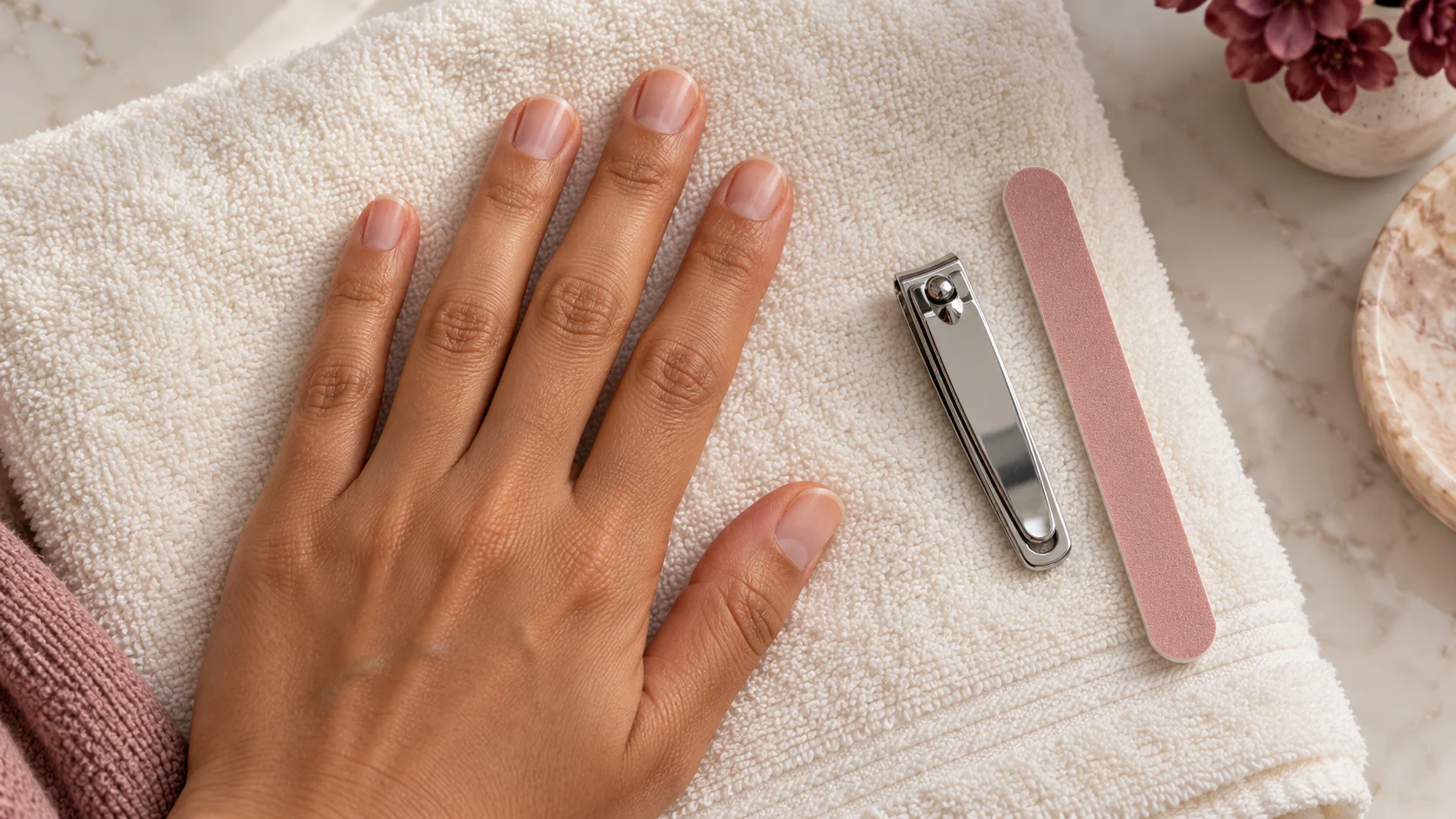
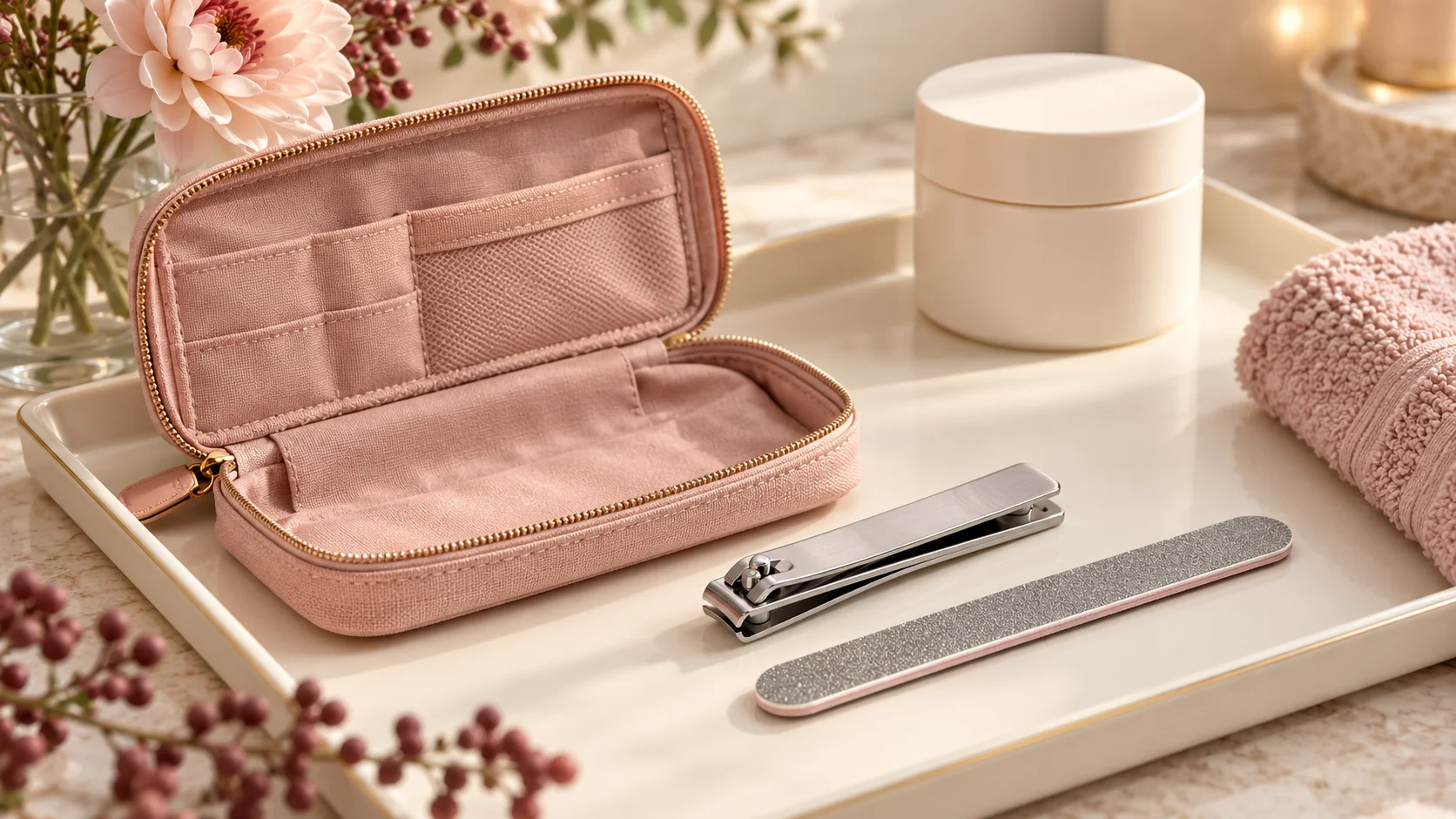
Lay out the kit on a suitable surface and identify each item. You may have a metal clipper, a coated file, a foam buffer, a glass file or an electrical tool. Similar-looking items can have different care instructions, and a material name alone may not describe coatings, glued parts or other components.
Find the manufacturer’s guidance for the exact model where possible. Save a photograph of the packaging or a link in one note. If there is no way to identify an inexpensive worn tool or its intended care, consider replacing it with one that has clearer instructions.
Include the storage case in the inventory. A fabric pouch, plastic tray and rigid box may need different care. A tool should not return to a dirty compartment simply because its own cleaning step is complete. Keep the case’s instructions alongside those for the contents.
Understand what the cleaning claim means
The US EPA distinguishes cleaning from disinfection: cleaning removes dirt and organic material, while disinfection uses a labelled process against specified microorganisms. The agency also stresses contact time, meaning the period a treated surface must remain wet when the directions require it.
That terminology does not make a US registration a UK product approval, nor does a general surface-disinfectant claim establish suitability for a particular manicure tool. Read both the tool’s care instructions and the cleaning product’s intended uses. They need to be compatible.
Do not treat a quick wipe, a pleasant scent or a clear-looking liquid as evidence that the required process has happened. Equally, adding more chemical is not a substitute for following directions. Concentration, contact time, rinsing and drying requirements belong to the specific product and application.
| Item | Check | Avoid assuming |
|---|---|---|
| Metal clipper | Maker’s cleaning and disinfection instructions | Every finish tolerates the same chemical |
| File or buffer | Reusable, washable or single-use status | Every abrasive can be soaked |
| Electrical tool | Device and attachment instructions | The whole unit can go in water |
| Storage case | Material and care directions | A tidy case is automatically clean |
Use a clear sequence instead of an improvised mixture
Write a short sequence for the items you actually own, using their instructions as the source. It might distinguish removing visible debris, a compatible cleaning step, any instructed disinfection process and the required finish before storage. Do not copy a sequence from a different tool simply to make all items match.
The AAD includes tool disinfection in its nail-trimming advice. Treat that as a reason to take tool care seriously while still checking material compatibility. It is not permission to immerse a porous buffer or electrical appliance in whatever product is nearest.
Keep chemicals in their original labelled containers and follow their safety directions. Do not combine products to make a stronger homemade solution. If you cannot establish an appropriate method, ask the manufacturer before using the tool again rather than testing a chemical on it and judging only by appearance.
Separate used items from ready-to-use items
A simple two-place arrangement can reduce confusion: one area for tools awaiting care, another for tools ready to put away. These are organisational labels, not a claim that either area is sterile. Choose surfaces and containers that you can care for according to their own instructions.
After grooming, place the used item in the first area immediately. Complete its care process before returning it to the main pouch. Leaving it loose among ready-to-use tools makes it harder to remember what happened, particularly if several people use the same bathroom storage space.
Allow items to reach the dry condition required by their instructions before closing the case. Do not use a zippered pouch as a drying rack. A convenient storage location should also keep sharp items and any cleaning products out of children’s reach.
Keep the kit personal
The NHS advises not sharing nail clippers or scissors. Give each household member an identifiable kit rather than relying on everyone to recognise one nearly identical clipper. A simple label on the case can make ownership clear.
If someone borrows an item, do not quietly return it to the ready-to-use compartment. Review what happened and the appropriate care or replacement step. Personal ownership is useful because it removes a recurring ambiguity; it does not remove the need to maintain your own tools.
If you suspect a nail infection, ask a pharmacist or clinician for suitable advice. Mention the tools involved where relevant. A general home-care article cannot confirm whether a particular implement should be retained after a specific exposure or how your individual treatment affects grooming.
Replace by condition and instructions, not by wishful thinking
Check tools when you put them away. A damaged edge, loose component, worn abrasive or material that is coming apart deserves attention. Keep the purchase details if a manufacturer may be able to advise. Do not keep using an item simply because the rest of the matching set still looks new.
Follow single-use instructions where they apply. Washing an item does not convert it into a reusable tool. Likewise, a label saying reusable does not mean it lasts indefinitely or tolerates every cleaning process.
Identify, follow, separate, store
- Identify: know the item and its intended use.
- Follow: use compatible manufacturer directions.
- Separate: keep used and prepared tools distinct.
- Store: put away dry, checked items in a cared-for case.
Use a care card for a mixed-material kit
A one-page care card can be more useful than remembering several different routines. Give each item its own line: exact name, source of instructions, permitted care method and replacement trigger. Include the date you checked the manufacturer’s guidance so you can find the same information again when a question arises.
Do not copy chemical quantities from an unrelated product onto the card. Instead, identify the product and the relevant directions, keeping the original label available. If you replace a clipper or file with a different model, update that line before using the new item. This prevents an old routine from following a new tool automatically. The card is an aid to organisation, not evidence that a household process has been professionally validated or that the tools are sterile.
Make the system easy to maintain
A kit with a few understood tools is easier to manage than a large collection of unexplained accessories. Keep the instructions together, remove items you cannot safely use and replenish only what the routine needs. Review the setup when you buy a new tool rather than assuming it belongs in an existing process.
For related grooming decisions, see our Nail Care guides. The useful outcome is a personal kit whose contents, condition and care history are clear enough that you do not need to guess at the next manicure.
For the related parts of your care routine, read How to Trim and File Natural Nails Without Overdoing It, Handwashing and Nail Care: Keeping Hands Clean Without Neglecting Moisture and Nail Care for Gardening: Gloves, Cleaning and Simple Protection. For the relevant product or service decision, see Glass Nail Files vs Emery Boards: Choosing a File for Your Routine.
Common questions
Does a clean-looking tool mean it is disinfected?
Appearance does not establish that a labelled disinfection process has been completed. Identify the tool, follow compatible care instructions and distinguish removing visible debris from any required disinfection step. A pleasant smell or a quick wipe is not a reliable substitute.
Can all files and buffers be soaked?
Check the exact item’s directions. Porous materials, coatings and glued components may have different requirements, and some items are intended for single use. Do not assume a process suitable for one metal implement is appropriate for every file or buffer.
Should a household share one manicure kit?
Give each person an identifiable personal kit rather than routinely sharing nail clippers or scissors. Clear ownership makes storage simpler, but your own tools still need appropriate care. Label the case if similar-looking implements would otherwise be difficult to distinguish.
Can I use a surface disinfectant on every tool?
Only when both the tool’s instructions and the product’s intended uses support that application. Check compatibility, directions and any required finishing steps. A general surface claim does not prove suitability for a coated file, electrical device or another specific manicure item.
Does home disinfection make a kit sterile?
Do not describe an ordinary home-care routine as sterilisation. This guide provides an organisational approach for personal grooming tools, not a validated professional process. Follow exact care directions and avoid extending a product’s claim beyond its stated use and conditions.
When should I replace a tool?
Follow its single-use or replacement instructions and inspect its condition. Worn abrasives, damaged edges or loose components are reasons to review the item. If the maker cannot clarify an appropriate care method, replacement with an identifiable tool may be the clearer choice.
Can I put tools straight into a closed pouch?
Complete their specified care process and allow the required drying before storage. Keep the pouch itself cared for according to its material instructions. A zippered case is useful for organisation, but it should not become a place to leave wet used items.
What should I do if I suspect an infection?
Seek suitable advice from a pharmacist or clinician and mention the tools involved if relevant. Do not rely on a generic cleaning routine to settle an individual exposure or treatment question. Keep the personal kit identifiable while you establish the appropriate next steps.
Sources and further reading
- AAD — How to trim your nails — checked 2026-10-21
- NHS — Fungal nail infection — checked 2026-10-21
- US EPA — Cleaning, sanitising and disinfecting — checked 2026-10-21