Do Nails Need to Breathe? Understanding Manicure Breaks
Understand what a manicure break can do, why the nail plate does not breathe, and when symptoms need assessment.
Archive edition: 2026-07-26 · This is an editorial allocation, not the first-publication date.
Key takeaways
- Reason: style choice, process review or a symptom?
- Removal: what is appropriate for the actual system?
- Care: which simple steps have been recommended?
- Review: what should guide the next appointment?
In this guide
- Key takeaways
- Separate the nail plate from the living tissues around it
- Ask what the break is for
- Consider the whole manicure process
- Do not remove a manicure aggressively to begin a break
- Keep the bare-nail routine uncomplicated
- Use observation without turning it into a home test
- Replace the breathing question with four practical ones
- Plan the return around the reason you paused
- Common questions
- Sources and further reading
Nails do not need to breathe in the way the phrase suggests. The visible nail plate is not a living surface that draws air through polish. However, taking a break from a manicure can still be useful for reasons involving the products, preparation, removal and condition of the nail. The misleading phrase should not obscure those practical questions.
Rather than asking only whether your nails need air, ask what the proposed break is intended to change. Is it time to assess a new symptom, pause repeated cosmetic procedures or simply enjoy bare nails? Those are different situations, and they do not share one guaranteed timetable.
Separate the nail plate from the living tissues around it
Nemours KidsHealth’s anatomy guide explains that new cells are produced in the matrix at the base of the nail. As they move forward and form the plate, they harden and die. The nail bed and surrounding tissues are different structures from that hardened plate.
This anatomy explains why “breathing through the nail” is an inaccurate description of what happens during a polish break. It does not mean the whole nail unit is insensitive or that any product can be applied without concern. Living skin and tissue remain around and beneath the plate.
Keep those two ideas together. Rejecting a myth about air does not establish that constant cosmetic procedures suit everyone. Equally, choosing a break does not require believing that the exposed plate is taking a breath. A useful explanation should name the actual concern.
Ask what the break is for
If you are simply changing your look, a bare-nail period is a cosmetic preference. You can plan it around comfort, convenience and your schedule. There is no need to describe every unpainted day as a treatment or recovery programme.
If nails are peeling, painful, lifting or otherwise changed, the question is different. A pause may create an opportunity to have the problem assessed, but waiting without advice does not identify the cause. Tell the professional what you noticed and which products or services preceded it.
If a clinician or provider recommends a break, ask which procedures or products they mean, what care should continue and when review is appropriate. “Take a break” can be too vague to use unless the reason and next step are clear.
| Reason | Useful question | What not to assume |
|---|---|---|
| A change of style | Would bare nails fit my current routine? | Every unpainted period is medical treatment |
| Repeated cosmetic maintenance | Which steps are we pausing and why? | All product systems have the same effects |
| A new nail concern | Does this need assessment now? | Time without polish provides a diagnosis |
| Individual professional advice | What care and follow-up were recommended? | Someone else’s timetable applies to me |
Consider the whole manicure process
A manicure is more than the colour visible in a photograph. It can involve preparation, product application, wear, maintenance and removal. When reviewing a concern, record those stages instead of attributing everything to the final colour layer.
The AAD’s artificial-nail guidance describes potential damage associated with preparation, removal and frequent maintenance. It also cautions against covering already damaged nails. Those concerns involve the actual process and nail condition, rather than a need for air to pass through the coating.
Ask the provider for the system name and removal approach. Do not assume that every service described as gel, builder or acrylic has identical instructions. If you change salons, share what you know and make any uncertainty explicit.
Do not remove a manicure aggressively to begin a break
A decision to pause does not make picking, peeling or scraping a suitable removal method. Arrange appropriate removal for the product that is actually present. If you do not know the system or the nail is uncomfortable, ask before acting.
The AAD’s gel-manicure guidance advises against picking gel and discusses time without polish and moisturising between manicures. It does not justify applying one removal recipe or a guaranteed recovery period to every reader and every enhancement system.
Tell the provider about lifting, discomfort or a previous reaction before the removal appointment. If symptoms are concerning, seek medical advice as well. The aim is to make an informed next decision, not to achieve bare nails as quickly as possible at any cost.
Keep the bare-nail routine uncomplicated
Follow any individual care advice and use suitable products according to their directions. You do not need to replace a removed manicure with a large collection of strengtheners, oils and masks. Ask what each proposed product is meant to do and whether it is necessary in your situation.
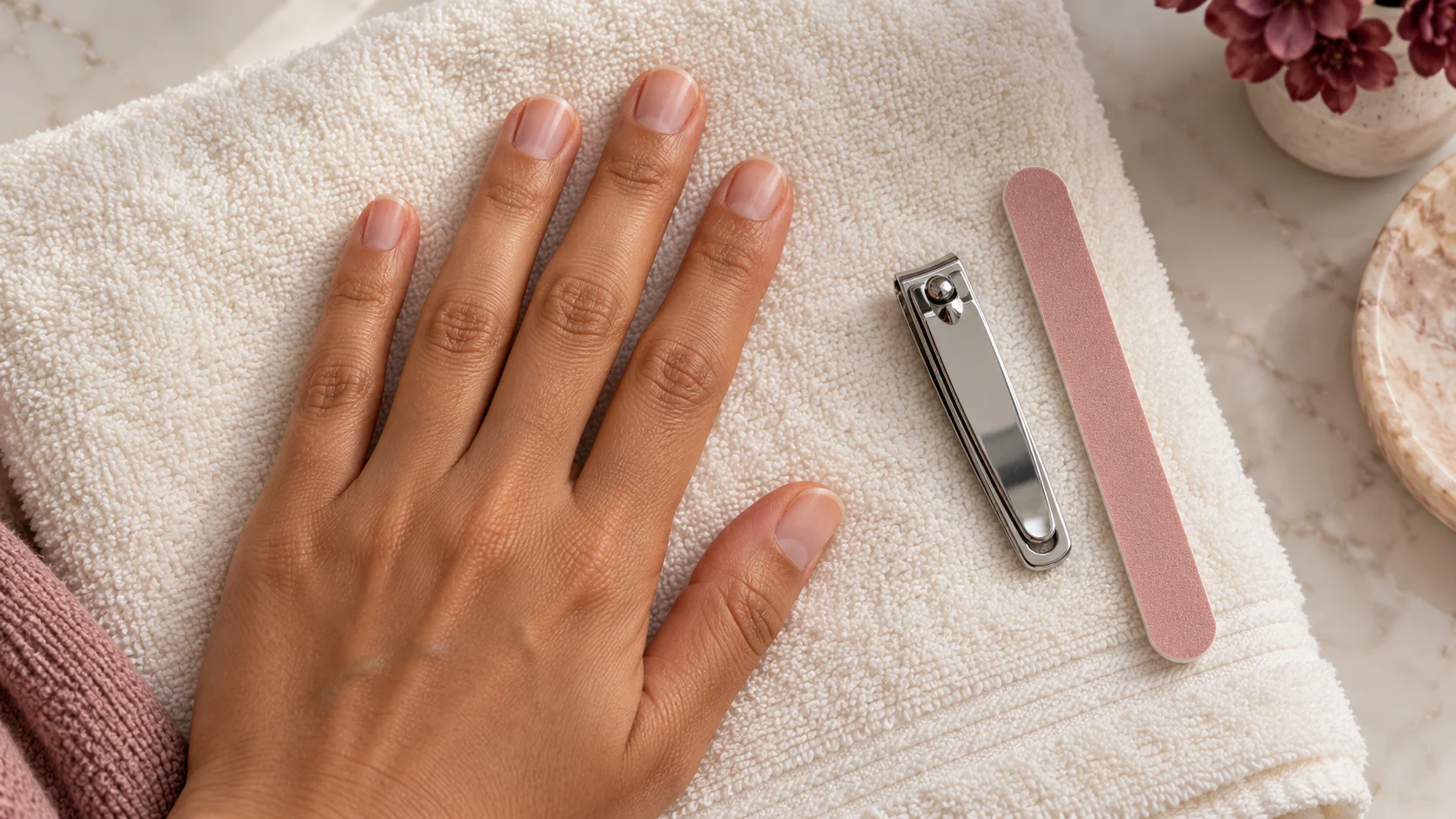
Keep a manageable length and organise ordinary tasks so nails are not used as substitute tools. If grooming is needed, make conservative adjustments in good light. A painful or unfamiliar change is not something to buff until the surface looks more uniform.
Enjoying the appearance of bare nails can be its own reason for the choice. Normal texture, small differences in outline and a less glossy finish do not make the routine unfinished. An editorial photograph is not a measurement of how a healthy nail must look.
Use observation without turning it into a home test
If you are monitoring a concern under advice, record what you can see and how it feels. Similar ordinary lighting and dated photographs can support a follow-up conversation. Do not bend, scrape or repeatedly press the nail to determine whether it has become stronger.
Distinguish appearance from the outcome you actually discussed. A smoother-looking surface does not necessarily answer a question about a reaction or a recurring problem. Ask the clinician or provider what should guide the next decision rather than relying on the photograph alone.
If pain, swelling, unusual colour or separation develops, seek appropriate advice instead of waiting for the end of a self-imposed break. A calendar date should not become a reason to ignore a new symptom.
Replace the breathing question with four practical ones
- Reason: style choice, process review or a symptom?
- Removal: what is appropriate for the actual system?
- Care: which simple steps have been recommended?
- Review: what should guide the next appointment?
Plan the return around the reason you paused
Before another manicure, revisit the original question. If the pause was a style preference, discuss the next look. If it followed a health concern, follow the relevant advice and share the history with the provider. Those decisions should not be collapsed into a universal number of bare-nail days.
Our Nail Care section covers related grooming and product questions. The useful distinction is straightforward: the plate does not need to breathe, while the nail unit and the cosmetic process still deserve thoughtful care and timely assessment of problems.
For the related parts of your care routine, read How to Care for Nails Between Salon Appointments, Looking After Natural Nails After Removing Extensions and Nail Peeling After a Manicure: Gentle Care and Warning Signs. For the relevant product or service decision, see How to Prepare for a Gel Removal Appointment.
Common questions
Do nails literally breathe through the surface?
No. The visible plate is formed from cells that harden and die, as described in the anatomy source. That does not make the surrounding nail unit insensitive or immune to problems. A manicure break should be explained through its actual purpose, not air passing through polish.
Does that mean a break from manicures is pointless?
No. A pause may be a style choice, a review of repeated cosmetic procedures or part of advice about a nail concern. Those are different reasons. Ask what is being paused, what care should continue and what should guide the next decision.
How long should every manicure break last?
There is no universal period in this guide that fits every service and nail condition. Follow advice relevant to your situation and clarify the reason for the pause. A fixed number of bare-nail days cannot diagnose a problem or guarantee that it has resolved.
Should I peel off gel to start the break immediately?
Do not pick or peel a coating to begin a break. Identify the actual system and arrange appropriate removal. Tell the provider about discomfort or visible changes, and seek medical advice for concerning symptoms rather than treating speed of removal as the only priority.
Do bare nails need a whole new product routine?
Not automatically. Use suitable products according to directions and any individual advice, and ask what each proposed addition is meant to do. A pause from colour does not require buying a large collection or treating normal surface variation as something that must be corrected.
Can a smoother appearance prove that recovery is complete?
Appearance alone may not answer the question that led to the pause. Ask what should guide follow-up, especially after a reaction or persistent problem. Keep observations factual and do not test strength by repeatedly bending, pressing or scraping the nail.
Is choosing bare nails a medical decision?
It can simply be a cosmetic preference or a convenient choice for your routine. You do not need to describe every unpainted day as treatment. If the choice follows symptoms, keep that separate health question clear and seek appropriate advice about it.
What should I discuss before returning to a salon service?
Revisit the reason you paused and share the product history and any relevant clinical instructions. Ask about the actual system, maintenance and removal. Do not replace that conversation with a universal timetable or assume that another person’s experience establishes readiness for you.
Sources and further reading
- Nemours KidsHealth — Nails — checked 2026-10-21
- AAD — Gel manicures and healthy nails — checked 2026-10-21
- AAD — Reducing artificial nail damage — checked 2026-10-21