Nail Polish Storage: Light, Heat and Bottle Care
Keep polish identifiable and properly closed, follow storage warnings and choose a practical place away from unsuitable heat and light.
Archive edition: 2026-08-28 · This is an editorial allocation, not the first-publication date.
Key takeaways
- Read the product-specific warnings.
- Choose suitable shade and distance from heat.
- Keep bottles closed and identifiable.
- Record opening information where useful.
- Ask the brand about changes instead of improvising fixes.
In this guide
- Key takeaways
- Read the storage warnings before choosing a container
- Choose shade and distance from heat thoughtfully
- Do not turn cool storage into a universal fridge rule
- Keep caps and bottle necks in usable condition
- Keep a simple opening and inventory record
- Handle travel and temporary storage deliberately
- When storage advice is not enough
- Common questions
- Sources and further reading
Good nail polish storage begins with the instructions on the product, then a practical place to keep it closed, identifiable and away from unsuitable conditions. A beautiful display is not necessarily the best storage location if it sits in direct sun, near heat or within easy reach of children.
This guide offers domestic organisation suggestions alongside manufacturer handling information. It does not establish one temperature, expiry period or storage appliance for every formula. Ordinary lacquer, lamp-cured products, removers and treatments may have different requirements, so read their labels separately rather than treating everything in a manicure kit as the same liquid.
Read the storage warnings before choosing a container
Start with the actual bottle, carton or leaflet. Look for temperature guidance, light precautions, fire warnings and directions to keep the container closed. If the label is damaged or missing, ask the manufacturer for the information associated with the exact product rather than reconstructing it from a similar-looking bottle.
GOV.UK’s consumer cosmetics guidance emphasises following instructions and keeping products out of children’s reach. An organiser should support those requirements. Open shelving can make colours easy to see, but accessibility is not always an advantage when the products need secure storage.
Keep original packaging where it carries information the bottle does not. You can save a clear photograph for reference, but do not let an inventory app replace a readable product identity. If you ever contact the supplier, the range and batch details are more useful than a memory of the cap colour.
Choose shade and distance from heat thoughtfully
Essie’s product FAQ advises keeping polish cool and out of direct sunlight, with the bottle neck clean and the cap tightly closed. That supports a simple starting point: consider a suitable shaded cupboard or drawer instead of a sunny windowsill.
Check how the location changes during the day. A shelf may be shaded in the morning and receive strong afternoon sun. A drawer near a heater can become warmer when the heating is on. The storage decision should reflect the actual room, not only how it looks when you first arrange the bottles.
The OPI Nail Lacquer safety data sheet also describes cool, dry, well-sealed storage and keeping ignition sources away. It is a US technical document dated 2023, so it provides supporting handling context rather than replacing the current directions on a product sold to you in the UK.
Do not turn cool storage into a universal fridge rule
Online storage tips are not always consistent, even across brand pages. A suggestion for one formula should not automatically become a recommendation to refrigerate or freeze every nail product. Read the exact product guidance and clarify uncertainty with the manufacturer before choosing an appliance or unusual storage method.
Do not improvise heating to make a cold or thick product easier to use. Storage and application instructions belong together, and a change in consistency is not permission to invent a temperature treatment. Keep products away from flame and other ignition sources according to their warnings.
If different sources conflict, identify which applies to your current range and packaging. A generic beauty tip, an old FAQ and a current local label may describe different products or contexts. Ask a precise question rather than combining the most convenient parts of several suggestions.
| Location or choice | What to check | Practical response |
|---|---|---|
| Open display shelf | Sunlight, heat and access by children | Choose a more suitable protected location if needed |
| Drawer or cupboard | Temperature, stability and readable labels | Use dividers without hiding important information |
| Travel bag | Caps, movement and hot storage conditions | Carry only what you need and follow transport guidance |
| Fridge or freezer suggestion | Whether the exact product supports that approach | Do not generalise an online tip |
| Mixed manicure kit | Different requirements for polish, gel and remover | Read each product’s warnings separately |
Keep caps and bottle necks in usable condition
A cap that closes properly is more useful than a perfectly colour-coordinated display. Follow the manufacturer’s bottle-care guidance and avoid leaving a product open while you search for other supplies. Prepare the workspace before opening the bottle so that closing it does not become an afterthought.
Do not force a damaged cap or cracked bottle back into service. If the closure no longer works reliably, ask the supplier how to handle the product and follow local disposal advice where appropriate. Decanting it into an unlabelled container loses the identity and warnings you need.
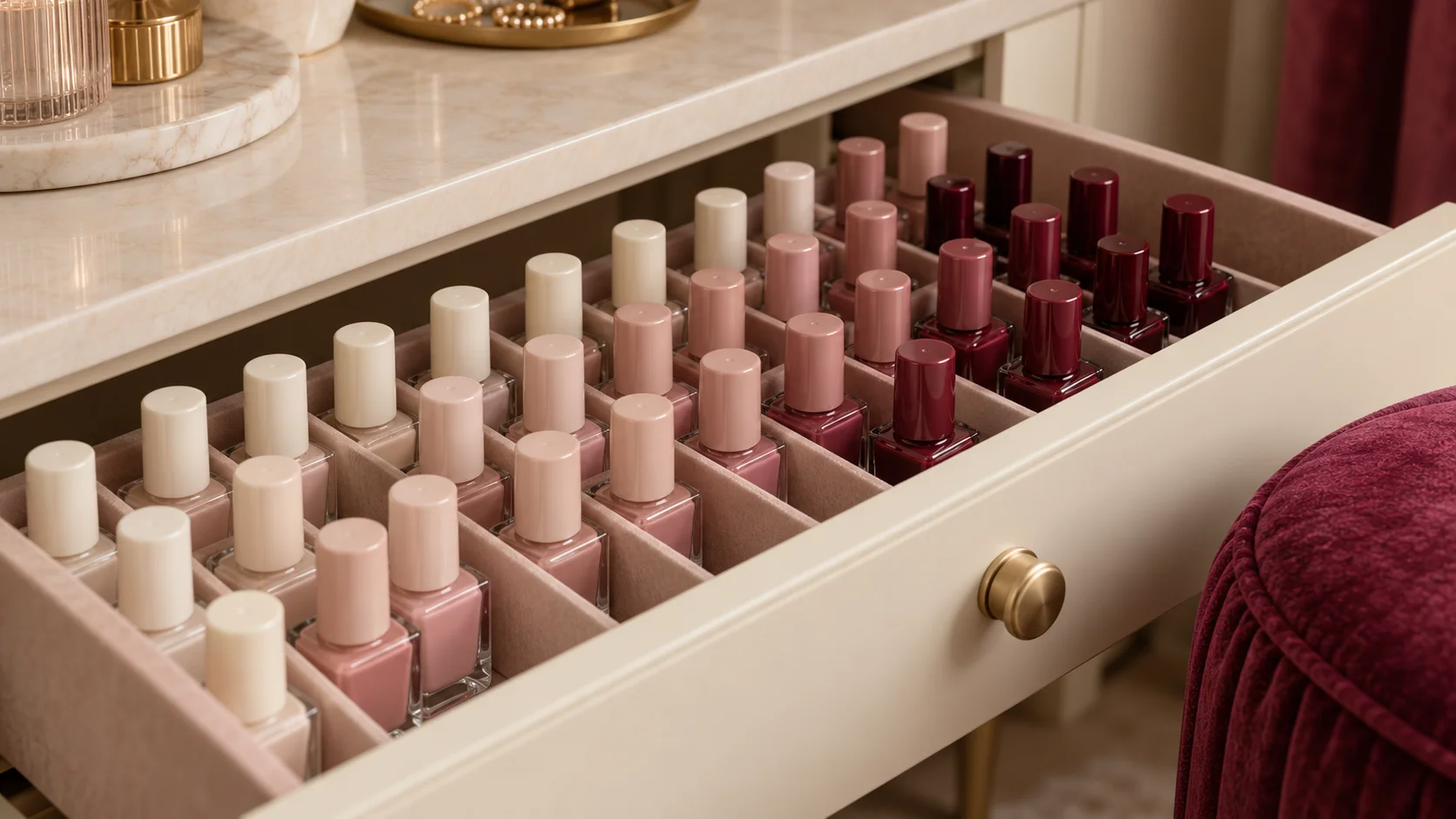
For organisation, upright bottles in suitable dividers can make labels easier to read and reduce unnecessary movement. This is a practical storage suggestion, not a claim that a particular divider material extends chemical shelf life. Leave enough room to lift a bottle without knocking neighbouring items over.
Keep a simple opening and inventory record
Record when you first open a product if its label uses period-after-opening information. Keep that separate from the purchase date and batch reference. These details answer different questions, and none should be converted into an invented universal expiry rule.
A small note with the range, shade and opening date is enough for many home collections. You do not need a complex spreadsheet unless you enjoy using one. The purpose is to prevent forgotten bottles and help you find the right directions, not to create extra administration for every manicure.
When reviewing the collection, look at the product’s own durability guidance and any changes that concern you. Do not assume that a bottle remains suitable forever because there is still liquid inside, or that every product must be discarded after the same fixed interval regardless of its label.
Handle travel and temporary storage deliberately
A travel pouch can keep items together, but it does not control temperature or replace secure closures. Avoid leaving a manicure kit in unsuitable heat, and check any carrier or destination requirements separately if you are travelling. This article does not establish airline liquid allowances or shipping permissions.
Take the original labelled products and the instructions needed for the planned routine. Carrying fewer compatible items can be easier to manage than a large mixed kit. If you cannot store or remove a particular manicure appropriately while away, consider whether a simpler routine would suit the trip.
After returning, put the products back in their normal storage location and check for leaks or damaged packaging. Do not ignore a closure problem simply because most of the product remains. A tidy bag is useful only when the containers inside are still fit for their intended use.
When storage advice is not enough
If a product has changed unexpectedly, contact the brand with its identity, batch information and storage history. Do not add remover, water or another liquid to make it appear normal unless the manufacturer explicitly supports a suitable product and method. Appearance alone cannot confirm that an improvised mixture is appropriate.
For unwanted or damaged products, use the label and relevant local waste guidance. Do not assume that all polish containers belong in the same recycling stream or that leftover liquid can be poured away. Disposal depends on the contents and local arrangements, so obtain the specific information you need.
Store for clarity and care
- Read the product-specific warnings.
- Choose suitable shade and distance from heat.
- Keep bottles closed and identifiable.
- Record opening information where useful.
- Ask the brand about changes instead of improvising fixes.
Find related bottle and formula guides in the Polish & Tools section. A manageable storage setup supports the product instructions and makes the next manicure easier to prepare without promising that any organiser can preserve polish indefinitely.
To compare the connected product and routine choices, read Thick Nail Polish: When to Check Storage, Age and Brand Advice, How to Read Nail Polish Ingredient and Safety Labels and Building a Small Nail Polish Collection with Versatile Colours. For the related care or design question, see How to Keep a Personal Manicure Kit Clean and Organised.
Common questions
Where should I keep nail polish at home?
Follow the actual product’s storage warnings and choose a suitable protected location away from unsuitable heat, direct sunlight and children’s access. A shaded drawer or cupboard may help with organisation, but check the real conditions rather than assuming any closed space is automatically appropriate.
Should all nail polish go in the fridge?
Do not turn a product-specific online tip into a rule for every formula. Brand advice can differ, and a storage appliance may not be appropriate for your products. Check the current label and ask the manufacturer about unclear or conflicting instructions before changing the storage method.
Can I warm a thick polish to make it usable?
Do not improvise heating or add liquids to change consistency. Follow the product’s directions and ask the brand about unexpected changes. Thickness alone does not identify a safe remedy, and storage or fire warnings remain relevant even when a bottle seems inconvenient to use.
Why does the bottle cap matter?
A proper closure helps keep the product contained and supports the manufacturer’s storage guidance. Keep the neck and cap in the condition the brand recommends and close the bottle after use. A damaged closure should be addressed rather than hidden by moving the liquid into an unlabelled container.
Does every polish expire after the same number of years?
No universal period is established here. Read the durability or period-after-opening information for the actual product and keep it separate from purchase and batch dates. Do not transfer one brand’s general FAQ timing to every lacquer, gel, treatment or remover in your collection.
Is an upright divider essential for preserving polish?
It is an organisational suggestion, not a proven shelf-life treatment. Suitable dividers can help keep bottles stable and labels visible, but they do not replace temperature, closure or safety instructions. Choose an arrangement that lets you remove one bottle without knocking or damaging others.
Can I store all manicure liquids together?
Read each product’s warnings first. Lacquers, lamp-cured products, removers and treatments can have different requirements. A shared pouch or drawer does not make those instructions identical, and every item should remain clearly labelled and securely closed in a location suitable for its contents.
How should I dispose of unwanted polish?
Use the product label and relevant local waste guidance for the contents and packaging. Do not assume leftover liquid can be poured away or that every bottle belongs in the same recycling stream. Ask the supplier or local service when the appropriate route is unclear.
Sources and further reading
- Essie — Storage FAQ — checked 2026-10-23
- OPI — Nail Lacquer safety data sheet — checked 2026-10-23
- GOV.UK — Consumer cosmetics guidance — checked 2026-10-23